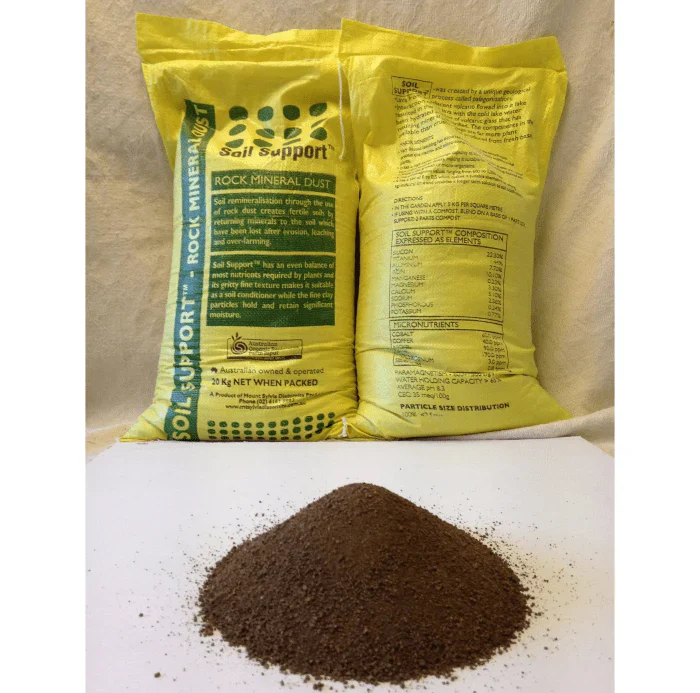
Soil Support Palagonite
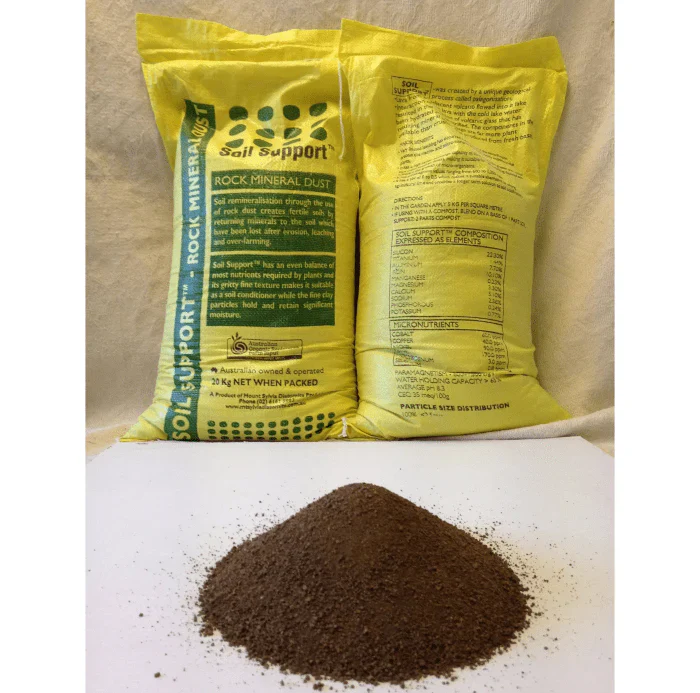
Palagonite Soil Support is a unique basalt rock dust soil re-mineraliser formed through a rare natural process at Mt Sylvia. It develops when water meets hot, flowing basalt lava, creating a nutrient-dense soil conditioner that surpasses standard rock mineral dusts.
What sets Mt Sylvia Palagonite apart? Unlike ordinary crusher dusts, it features an exceptional Cation Exchange Capacity (CEC) of around 34 meq/100g, far higher than the typical 4–14 meq/100g found in standard basalt dust. This results in superior nutrient and water retention for healthier, more resilient plants.
Disclaimer: Only the 20 kg size is supplied in original packaging. The 5 kg size is repacked from 20 kg bags into clear bags.
Palagonite delivers essential macronutrients—calcium, magnesium, phosphorus, potassium—as well as iron and plant-available silica. It also contains a wide range of valuable micronutrients and trace elements including cobalt, zinc, copper, selenium and more, supporting healthy soil, plants, animals, and people.
Benefits
-
Reduces soil compaction
-
Improves water-holding capacity
-
Enhances the environment for beneficial soil microbes
-
Supports long-term soil pH and overall soil health
-
Helps moderate water availability (absorbs up to 50% of its weight)
Pro Tip: For best results, mix Palagonite 50/50 with composted material or manure to accelerate nutrient availability through microbial activity.
Give your soil a natural, sustainable boost with Palagonite Soil Support—the smart choice for organic growers who know that healthy soil grows healthy plants.
Typical Analysis
Macronutrients & Elements:
Silica 22.30%
Aluminium 7.70%
Iron 10.10%
Manganese 0.23%
Magnesium 3.30%
Calcium 5.10%
Sodium 2.36%
Phosphorus 0.24%
Potassium 0.77%
Total Carbon 0.08%
Total Nitrogen 0.03%
pH 8–8.5
Micronutrients & Trace Elements:
Cobalt 60 ppm
Copper 40 ppm
Nickel 90 ppm
Zinc 170 ppm
Molybdenum 1–3 ppm
Selenium 0.3–0.8 ppm
Chloride ~62 ppm
Sulphur 4.4 ppm
Boron 0.06 ppm
Additional Properties:
Paramagnetism: 600–1300 c/g/s
Water-holding capacity: >65%
Cation Exchange Capacity (CEC): 35 meq/100g
Why Palagonite Outperforms Other Rock Dusts
When Mt Sylvia Diatomite Pty Ltd acquired the diatomaceous earth mine in 2005, it also established a quarry to extract altered basalt overburden. During this process, the company discovered that the altered basalt—now known as Palagonite—offered significantly greater benefits for plant and soil health than standard blue metal crusher dust.
Most basalt quarries produce aggregates for road construction, with crusher dust as a by-product. This fine, crystalline dust has been used as a natural rock mineral fertiliser, especially by organic growers seeking an alternative to chemical NPK fertilisers.
Palagonite provides similar re-mineralisation benefits but with far superior performance. Its fine particles reduce compaction, improve water retention, and create a more hospitable environment for beneficial soil microbes. Blending Palagonite with compost or manure speeds up nutrient cycling, as bacteria and fungi transport minerals directly to plant roots.
Mt Sylvia Palagonite supplies key macronutrients (calcium, magnesium, phosphorus, minor potassium), iron, and plant-available silica, along with an extensive suite of trace minerals such as cobalt, zinc, copper, nickel, molybdenum, and selenium—all essential for plant, human, and animal health.
Because of its largely amorphous structure and moderate smectite clay content, Palagonite acts as both a supplier and a reservoir of plant-available nutrients. Its CEC (~34 meq/100g) far exceeds typical quarry basalt dust (4–14 meq/100g), meaning significantly higher nutrient and water retention. Palagonite also shows strong paramagnetic properties (600–1300°C), contributing to improved soil vitality.
Application Guidelines
Application rates vary, but a generous initial application is recommended. Since Palagonite minerals release slowly, the goal is to establish a long-term reserve of nutrients for soil microbes and fungi to access as required.
Backyard vegetable gardens:
Apply approximately 1 kg per m², combined with a similar amount of compost or manure.
Tree planting:
Higher quantities may be beneficial.
Commercial example:
At Bauer’s Organic Farms, the coarse fraction (-5 mm) is applied with composted chicken manure at 12 tonnes/ha (6 tonnes of Palagonite + 6 tonnes of manure).
Original: $25.30
-65%$25.30
$8.86More Images
Soil Support Palagonite
Palagonite Soil Support is a unique basalt rock dust soil re-mineraliser formed through a rare natural process at Mt Sylvia. It develops when water meets hot, flowing basalt lava, creating a nutrient-dense soil conditioner that surpasses standard rock mineral dusts.
What sets Mt Sylvia Palagonite apart? Unlike ordinary crusher dusts, it features an exceptional Cation Exchange Capacity (CEC) of around 34 meq/100g, far higher than the typical 4–14 meq/100g found in standard basalt dust. This results in superior nutrient and water retention for healthier, more resilient plants.
Disclaimer: Only the 20 kg size is supplied in original packaging. The 5 kg size is repacked from 20 kg bags into clear bags.
Palagonite delivers essential macronutrients—calcium, magnesium, phosphorus, potassium—as well as iron and plant-available silica. It also contains a wide range of valuable micronutrients and trace elements including cobalt, zinc, copper, selenium and more, supporting healthy soil, plants, animals, and people.
Benefits
-
Reduces soil compaction
-
Improves water-holding capacity
-
Enhances the environment for beneficial soil microbes
-
Supports long-term soil pH and overall soil health
-
Helps moderate water availability (absorbs up to 50% of its weight)
Pro Tip: For best results, mix Palagonite 50/50 with composted material or manure to accelerate nutrient availability through microbial activity.
Give your soil a natural, sustainable boost with Palagonite Soil Support—the smart choice for organic growers who know that healthy soil grows healthy plants.
Typical Analysis
Macronutrients & Elements:
Silica 22.30%
Aluminium 7.70%
Iron 10.10%
Manganese 0.23%
Magnesium 3.30%
Calcium 5.10%
Sodium 2.36%
Phosphorus 0.24%
Potassium 0.77%
Total Carbon 0.08%
Total Nitrogen 0.03%
pH 8–8.5
Micronutrients & Trace Elements:
Cobalt 60 ppm
Copper 40 ppm
Nickel 90 ppm
Zinc 170 ppm
Molybdenum 1–3 ppm
Selenium 0.3–0.8 ppm
Chloride ~62 ppm
Sulphur 4.4 ppm
Boron 0.06 ppm
Additional Properties:
Paramagnetism: 600–1300 c/g/s
Water-holding capacity: >65%
Cation Exchange Capacity (CEC): 35 meq/100g
Why Palagonite Outperforms Other Rock Dusts
When Mt Sylvia Diatomite Pty Ltd acquired the diatomaceous earth mine in 2005, it also established a quarry to extract altered basalt overburden. During this process, the company discovered that the altered basalt—now known as Palagonite—offered significantly greater benefits for plant and soil health than standard blue metal crusher dust.
Most basalt quarries produce aggregates for road construction, with crusher dust as a by-product. This fine, crystalline dust has been used as a natural rock mineral fertiliser, especially by organic growers seeking an alternative to chemical NPK fertilisers.
Palagonite provides similar re-mineralisation benefits but with far superior performance. Its fine particles reduce compaction, improve water retention, and create a more hospitable environment for beneficial soil microbes. Blending Palagonite with compost or manure speeds up nutrient cycling, as bacteria and fungi transport minerals directly to plant roots.
Mt Sylvia Palagonite supplies key macronutrients (calcium, magnesium, phosphorus, minor potassium), iron, and plant-available silica, along with an extensive suite of trace minerals such as cobalt, zinc, copper, nickel, molybdenum, and selenium—all essential for plant, human, and animal health.
Because of its largely amorphous structure and moderate smectite clay content, Palagonite acts as both a supplier and a reservoir of plant-available nutrients. Its CEC (~34 meq/100g) far exceeds typical quarry basalt dust (4–14 meq/100g), meaning significantly higher nutrient and water retention. Palagonite also shows strong paramagnetic properties (600–1300°C), contributing to improved soil vitality.
Application Guidelines
Application rates vary, but a generous initial application is recommended. Since Palagonite minerals release slowly, the goal is to establish a long-term reserve of nutrients for soil microbes and fungi to access as required.
Backyard vegetable gardens:
Apply approximately 1 kg per m², combined with a similar amount of compost or manure.
Tree planting:
Higher quantities may be beneficial.
Commercial example:
At Bauer’s Organic Farms, the coarse fraction (-5 mm) is applied with composted chicken manure at 12 tonnes/ha (6 tonnes of Palagonite + 6 tonnes of manure).
Product Information
Product Information
Shipping & Returns
Shipping & Returns
Description
Palagonite Soil Support is a unique basalt rock dust soil re-mineraliser formed through a rare natural process at Mt Sylvia. It develops when water meets hot, flowing basalt lava, creating a nutrient-dense soil conditioner that surpasses standard rock mineral dusts.
What sets Mt Sylvia Palagonite apart? Unlike ordinary crusher dusts, it features an exceptional Cation Exchange Capacity (CEC) of around 34 meq/100g, far higher than the typical 4–14 meq/100g found in standard basalt dust. This results in superior nutrient and water retention for healthier, more resilient plants.
Disclaimer: Only the 20 kg size is supplied in original packaging. The 5 kg size is repacked from 20 kg bags into clear bags.
Palagonite delivers essential macronutrients—calcium, magnesium, phosphorus, potassium—as well as iron and plant-available silica. It also contains a wide range of valuable micronutrients and trace elements including cobalt, zinc, copper, selenium and more, supporting healthy soil, plants, animals, and people.
Benefits
-
Reduces soil compaction
-
Improves water-holding capacity
-
Enhances the environment for beneficial soil microbes
-
Supports long-term soil pH and overall soil health
-
Helps moderate water availability (absorbs up to 50% of its weight)
Pro Tip: For best results, mix Palagonite 50/50 with composted material or manure to accelerate nutrient availability through microbial activity.
Give your soil a natural, sustainable boost with Palagonite Soil Support—the smart choice for organic growers who know that healthy soil grows healthy plants.
Typical Analysis
Macronutrients & Elements:
Silica 22.30%
Aluminium 7.70%
Iron 10.10%
Manganese 0.23%
Magnesium 3.30%
Calcium 5.10%
Sodium 2.36%
Phosphorus 0.24%
Potassium 0.77%
Total Carbon 0.08%
Total Nitrogen 0.03%
pH 8–8.5
Micronutrients & Trace Elements:
Cobalt 60 ppm
Copper 40 ppm
Nickel 90 ppm
Zinc 170 ppm
Molybdenum 1–3 ppm
Selenium 0.3–0.8 ppm
Chloride ~62 ppm
Sulphur 4.4 ppm
Boron 0.06 ppm
Additional Properties:
Paramagnetism: 600–1300 c/g/s
Water-holding capacity: >65%
Cation Exchange Capacity (CEC): 35 meq/100g
Why Palagonite Outperforms Other Rock Dusts
When Mt Sylvia Diatomite Pty Ltd acquired the diatomaceous earth mine in 2005, it also established a quarry to extract altered basalt overburden. During this process, the company discovered that the altered basalt—now known as Palagonite—offered significantly greater benefits for plant and soil health than standard blue metal crusher dust.
Most basalt quarries produce aggregates for road construction, with crusher dust as a by-product. This fine, crystalline dust has been used as a natural rock mineral fertiliser, especially by organic growers seeking an alternative to chemical NPK fertilisers.
Palagonite provides similar re-mineralisation benefits but with far superior performance. Its fine particles reduce compaction, improve water retention, and create a more hospitable environment for beneficial soil microbes. Blending Palagonite with compost or manure speeds up nutrient cycling, as bacteria and fungi transport minerals directly to plant roots.
Mt Sylvia Palagonite supplies key macronutrients (calcium, magnesium, phosphorus, minor potassium), iron, and plant-available silica, along with an extensive suite of trace minerals such as cobalt, zinc, copper, nickel, molybdenum, and selenium—all essential for plant, human, and animal health.
Because of its largely amorphous structure and moderate smectite clay content, Palagonite acts as both a supplier and a reservoir of plant-available nutrients. Its CEC (~34 meq/100g) far exceeds typical quarry basalt dust (4–14 meq/100g), meaning significantly higher nutrient and water retention. Palagonite also shows strong paramagnetic properties (600–1300°C), contributing to improved soil vitality.
Application Guidelines
Application rates vary, but a generous initial application is recommended. Since Palagonite minerals release slowly, the goal is to establish a long-term reserve of nutrients for soil microbes and fungi to access as required.
Backyard vegetable gardens:
Apply approximately 1 kg per m², combined with a similar amount of compost or manure.
Tree planting:
Higher quantities may be beneficial.
Commercial example:
At Bauer’s Organic Farms, the coarse fraction (-5 mm) is applied with composted chicken manure at 12 tonnes/ha (6 tonnes of Palagonite + 6 tonnes of manure).