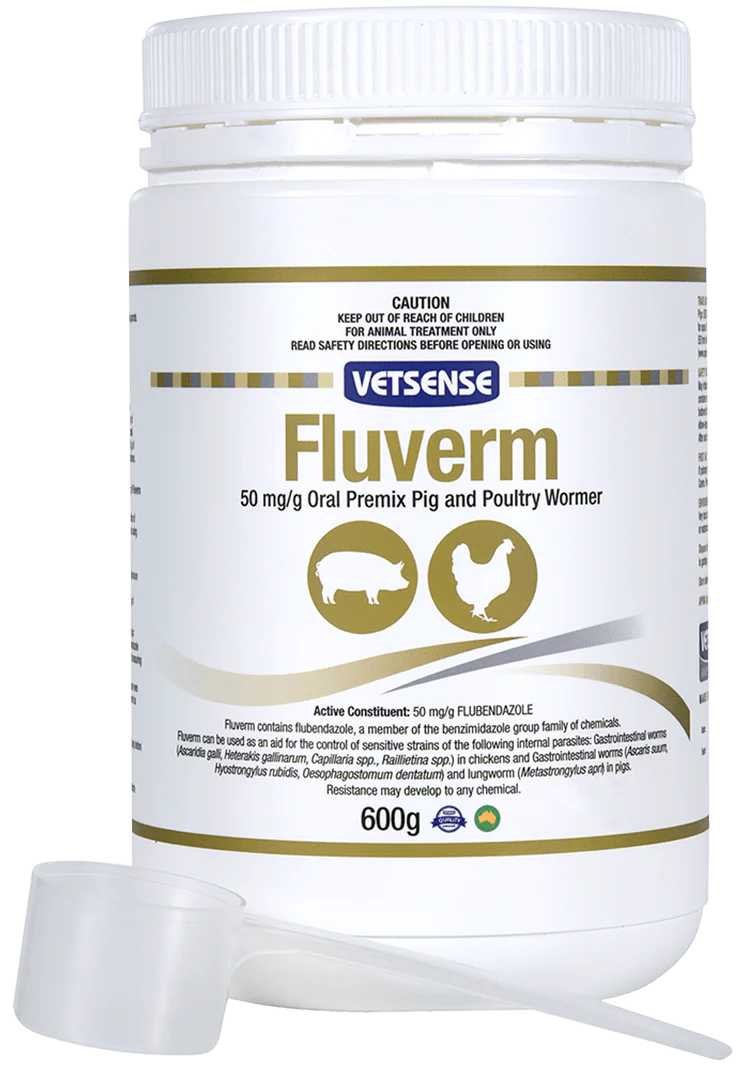
Vetsense Fluverm Pig and Poultry Wormer
Fluverm is an in-feed powdered wormer used to aid and control sensitive strains of internal parasites in pigs and poultry.
- Easily mixed into daily feed rations.
- Effective against all stages of worms in poultry including tapeworm.
- No effect on egg production (fertility or hatchability)
- No effect on fertility or embryo formation in pigs.
- This is an egg-safe product (zero withholding)
Chickens
Ascaridia gali, Heterakis gallinarum, Capillaria spp.
600 g of Fluverm per tonne of feed (equivalent to 30 g of flubendazole (30 ppm)) for 7 consecutive days.
For small numbers of animals, 1 supplied measuring spoon (13 g) of Fluverm is mixed into 21.5 kg of compound feed chickens.
Tapeworm (Raillietina spp.):
1200 g of Fluverm per tonne of feed(equivalent to 60 g of Fluverm (60 ppm)) for 7 consecutive days.
Ensure birds have access to feed to enable consumption of the required dose. Optimum results are achieved when using stringent chicken housing hygiene requirements.
Pigs
Ascaris suum, Hyostrongylus rubidis, Oesophagostomum dentatum and Metastrongylus apri.
600 g of Fluverm per tonne of feed (equivalent to 30 g of flubendazole (30 ppm)) for 10 consecutive days.
Individual and single administration to breeding pigs:
Fluverm is mixed into the feed at a dose of 5 mg flubendazole per Kg body weight. This corresponds to one supplied measuring spoon (13 g) of Fluverm per 130 kg of body weight.
Fluverm should be thoroughly mixed into feed to ensure even distribution of the medication.
Feed can be administered as a mash, crumble or pellet.
APVMA Registration: 93835/140613
Fluverm contains flubendazole, a member of the benzimidazole group family of chemicals.
Fluverm can be used as an aid for the control of sensitive strains of the following internal parasites: Gastrointestinal worms (Ascaridia galli, Heterakis gallinarum, Capillaria spp., Raillietina spp.) in chickens and Gastrointestinal worms (Ascaris suum, Hyostrongylus rubidis, Oesophagostomum dentatum) and lungworm (Metastrongylus apri) in pigs.
Resistance may develop to any chemical.
Original: $50.24
-65%$50.24
$17.58Vetsense Fluverm Pig and Poultry Wormer
Fluverm is an in-feed powdered wormer used to aid and control sensitive strains of internal parasites in pigs and poultry.
- Easily mixed into daily feed rations.
- Effective against all stages of worms in poultry including tapeworm.
- No effect on egg production (fertility or hatchability)
- No effect on fertility or embryo formation in pigs.
- This is an egg-safe product (zero withholding)
Chickens
Ascaridia gali, Heterakis gallinarum, Capillaria spp.
600 g of Fluverm per tonne of feed (equivalent to 30 g of flubendazole (30 ppm)) for 7 consecutive days.
For small numbers of animals, 1 supplied measuring spoon (13 g) of Fluverm is mixed into 21.5 kg of compound feed chickens.
Tapeworm (Raillietina spp.):
1200 g of Fluverm per tonne of feed(equivalent to 60 g of Fluverm (60 ppm)) for 7 consecutive days.
Ensure birds have access to feed to enable consumption of the required dose. Optimum results are achieved when using stringent chicken housing hygiene requirements.
Pigs
Ascaris suum, Hyostrongylus rubidis, Oesophagostomum dentatum and Metastrongylus apri.
600 g of Fluverm per tonne of feed (equivalent to 30 g of flubendazole (30 ppm)) for 10 consecutive days.
Individual and single administration to breeding pigs:
Fluverm is mixed into the feed at a dose of 5 mg flubendazole per Kg body weight. This corresponds to one supplied measuring spoon (13 g) of Fluverm per 130 kg of body weight.
Fluverm should be thoroughly mixed into feed to ensure even distribution of the medication.
Feed can be administered as a mash, crumble or pellet.
APVMA Registration: 93835/140613
Fluverm contains flubendazole, a member of the benzimidazole group family of chemicals.
Fluverm can be used as an aid for the control of sensitive strains of the following internal parasites: Gastrointestinal worms (Ascaridia galli, Heterakis gallinarum, Capillaria spp., Raillietina spp.) in chickens and Gastrointestinal worms (Ascaris suum, Hyostrongylus rubidis, Oesophagostomum dentatum) and lungworm (Metastrongylus apri) in pigs.
Resistance may develop to any chemical.
Product Information
Product Information
Shipping & Returns
Shipping & Returns
Description
Fluverm is an in-feed powdered wormer used to aid and control sensitive strains of internal parasites in pigs and poultry.
- Easily mixed into daily feed rations.
- Effective against all stages of worms in poultry including tapeworm.
- No effect on egg production (fertility or hatchability)
- No effect on fertility or embryo formation in pigs.
- This is an egg-safe product (zero withholding)
Chickens
Ascaridia gali, Heterakis gallinarum, Capillaria spp.
600 g of Fluverm per tonne of feed (equivalent to 30 g of flubendazole (30 ppm)) for 7 consecutive days.
For small numbers of animals, 1 supplied measuring spoon (13 g) of Fluverm is mixed into 21.5 kg of compound feed chickens.
Tapeworm (Raillietina spp.):
1200 g of Fluverm per tonne of feed(equivalent to 60 g of Fluverm (60 ppm)) for 7 consecutive days.
Ensure birds have access to feed to enable consumption of the required dose. Optimum results are achieved when using stringent chicken housing hygiene requirements.
Pigs
Ascaris suum, Hyostrongylus rubidis, Oesophagostomum dentatum and Metastrongylus apri.
600 g of Fluverm per tonne of feed (equivalent to 30 g of flubendazole (30 ppm)) for 10 consecutive days.
Individual and single administration to breeding pigs:
Fluverm is mixed into the feed at a dose of 5 mg flubendazole per Kg body weight. This corresponds to one supplied measuring spoon (13 g) of Fluverm per 130 kg of body weight.
Fluverm should be thoroughly mixed into feed to ensure even distribution of the medication.
Feed can be administered as a mash, crumble or pellet.
APVMA Registration: 93835/140613
Fluverm contains flubendazole, a member of the benzimidazole group family of chemicals.
Fluverm can be used as an aid for the control of sensitive strains of the following internal parasites: Gastrointestinal worms (Ascaridia galli, Heterakis gallinarum, Capillaria spp., Raillietina spp.) in chickens and Gastrointestinal worms (Ascaris suum, Hyostrongylus rubidis, Oesophagostomum dentatum) and lungworm (Metastrongylus apri) in pigs.
Resistance may develop to any chemical.